Main content blocks
Section outline
-
-
Students mustMark as done
Welcome! This self-paced course was created as part of the CRAFT-OA project by Anastasiia Afanaseva and edited by Jorina Fenner and Xenia van Edig at TIB – Leibniz Information Centre for Science and Technology. It represents the first version of this course, published in June 2025.
The course is split in two parts: The present course introduces practical first steps in digital preservation of journals. The second course has a focus on the principles of digital archiving and how it works.
-
Students mustMark as done
Who is this course designed for?
The couse is primarly designed for Diamond OA journal publishers and editors. Therefore, it assumes a certain level of knowledge in the field of Open Access, but does not require familiarity with digital preservation.
What will you know or be able to do after completing the course?
- You will be able to tell the key characteristics of digital preservation/long-term archiving.
- You will be able to list what options are available for long-term archiving.
- You will be able to indentify the most appropriate option (preferably more than one) for your journal's long-term archiving.
- You will be able to take the first steps of implementing one or more of these options for journal long-term archiving.
How to use this self-paced course?
Particants may choose the topic of their interest from the table of contents on the left or go through the course consecutively. In this way, you may also choose the level of detail that you wish to persue on a given topic. At the end of each section you will be able to test what you have learned in a short exercise.No login or account are required, you can work on the material at your own pace and return to it at any point in time. The section "Additional material" provides insights on how the topics for this course were selected.
-
-
-
Students mustMark as done
If you are unsure about the status the journal that you would like to preserve, there are options to check this: Although it is not possible to check against all existing preservation services at once, this section will introduce how to run a check on the Keepers Registry and in the Fatcat Wiki.
In the Keepers Registry status information for a given ISSN number can be checked. This is an official way that is preferrable when checking only several journals.
Here is an example for the information provided in the case of the Journal of the Association for Information Science and Technology:
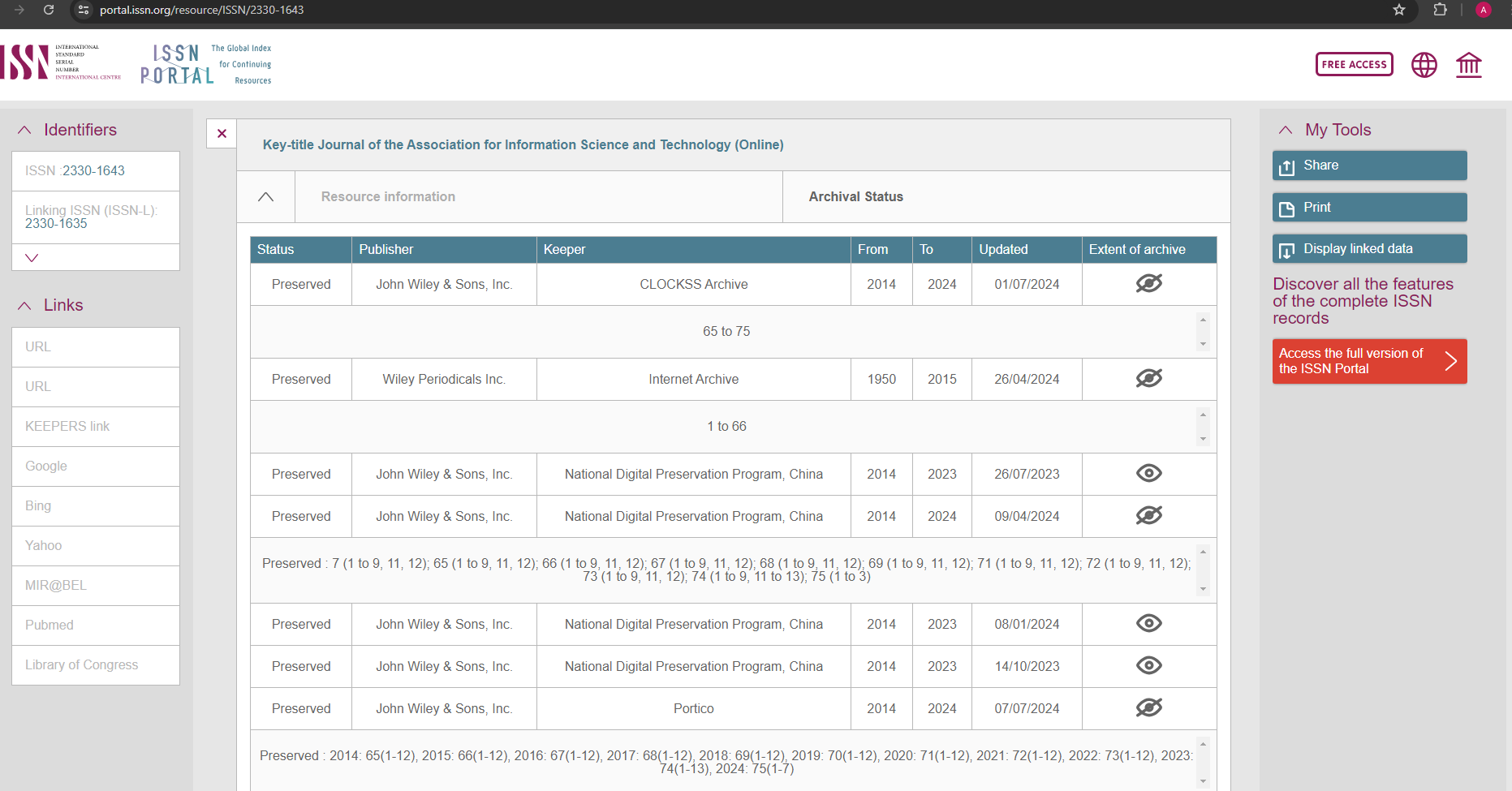
Image: Search result for the Journal of the Association for Information Science and Technology in the Keepers Registry: https://portal.issn.org/resource/ISSN/2330-1643
Another resource that is collecting the data from archiving agencies and visualizing it is Fatcat Wiki, run by Internet Archive.Here is an example of the information given about the same journal there: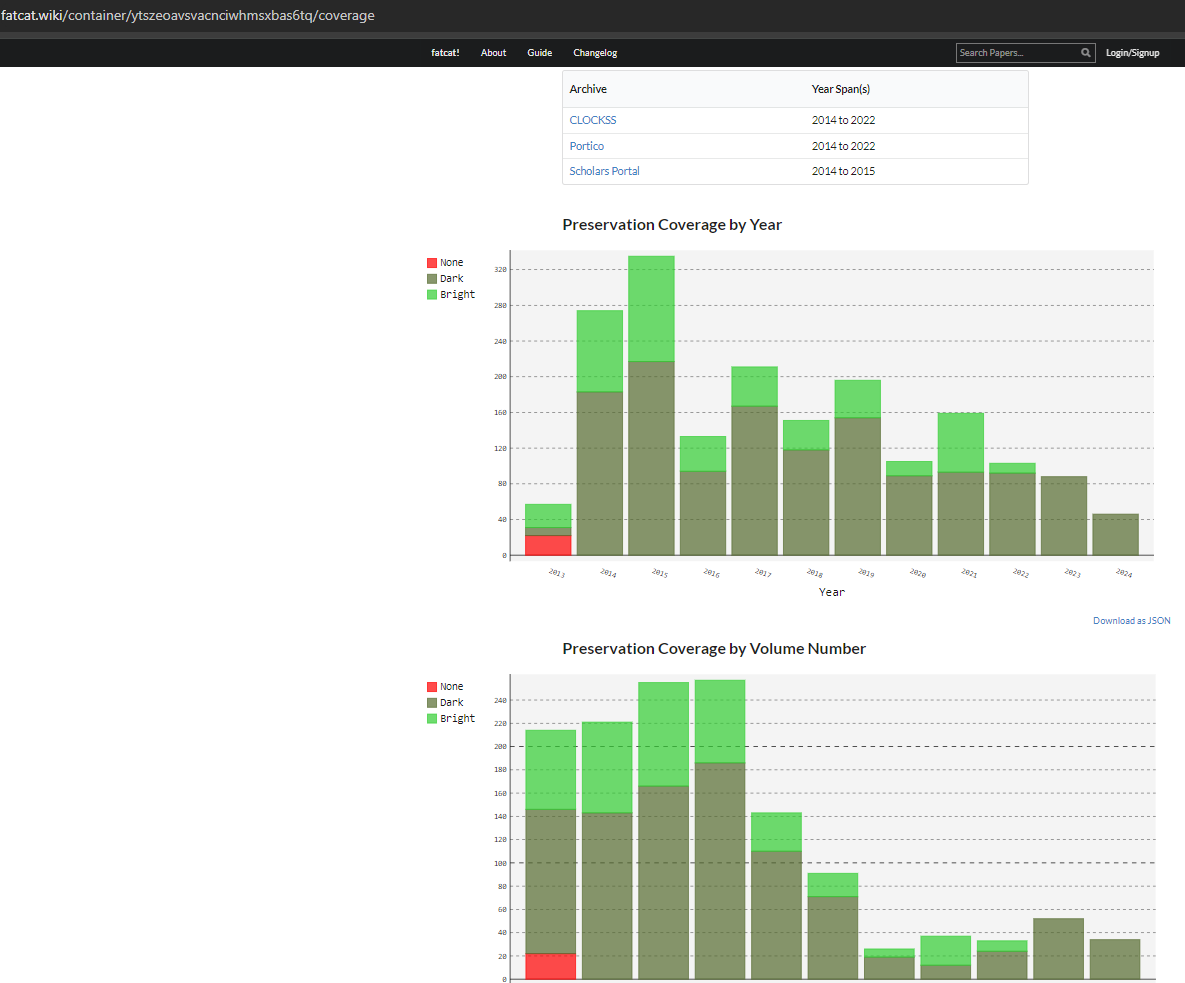
Image: Search result for Journal of the Association for Information Science and Technology in the Fatcat Wiki: https://fatcat.wiki/container/ytszeoavsvacnciwhmsxbas6tq/coverage
Only three preservation services are indexed in Fatcat Wiki for this example out of five indexed in Keepers. Notably, the Internet Archive, which hosts Fatcat Wiki, is not indexed there for this particular journal, but only in Keepers.If you are interested in checking the information for many journals at once, there are several ways to proceed:- by downloading the lists from the preservation services (CSV/TSV files) - This is the easiest way without technical know-how, using only official data. However, not all of the services provide such lists. The links to them are listed e.g. in https://the-vault.fly.dev/Data_Validation_and_Sources
- by using the Fatcat API. This requires some technical know-how and the reliability of the data should be checked.
- by using the data from Crossref Preservation Database which "returns the preservation status of a Crossref DOI matched against mainstream digital preservation platforms". this also requires a certain technical know-how.
- by downloading the lists from the preservation services (CSV/TSV files) - This is the easiest way without technical know-how, using only official data. However, not all of the services provide such lists. The links to them are listed e.g. in https://the-vault.fly.dev/Data_Validation_and_Sources
-
Students mustMark as doneLet's try and follow the instructions above. Are you able to find out about the status of your journal? Is you journal already part of a long-term archiving system?
-
-
-
Students mustMark as done
Many Diamond OA journals oparate with a very limited budget and are heavily reliant on in-kind contributions of their editors. Therefore, this list summarises possibilities for preservation that are free of charge for the journal:
- Check with your institutional library, national library, and publishing platform. They may have options for you!
- If a journal uses OJS, it is possible to use PKP Preservation Network free of charge: https://docs.pkp.sfu.ca/pkp-pn/en/
- If a journal is listed in DOAJ, it is possible to apply for it to be preserved via the JASPER project in one of the following ways:
- The OJS route: (guidance for PKP PN usage)
- "The upload route: journals indicate to DOAJ that they wish to preserve their content with CLOCKSS. DOAJ matches the full text sent to them with the article metadata that they hold. We send everything to a remote folder. From this single location, archiving agencies, such as CLOCKSS and Internet Archive (and, later, other “Keepers”) collect the content.
- The web-crawling route: if you cannot or do not want to export article metadata and full text, your journal website details will be provided to the Internet Archive for inclusion in a best-effort, automated web harvesting.
- Check a list of LOCKSS communities for specific national and local options (https://www.lockss.org/join-lockss/networks; https://www.lockss.org/join-lockss/case-studies); you can also try to apply to be preserved in GLN LOCKSS (https://www.lockss.org/gln#publishers).
-
-
-
Students mustMark as doneAlongside contacting experts from your local or national institutions, such as your libraries, and the preservation services, it may be of use to consider these collected ressources to gain an overview:
DIAMAS Deliverable 5.2 National overviews on sustaining institutional publishing in Europe: https://zenodo.org/doi/10.5281/zenodo.11383941
CRAFT-OA Deliverable 3.2: Report on challenges and help measures faced by OA journals and platforms: https://zenodo.org/doi/10.5281/zenodo.10496594
CRAFT-OA Deliverable 3.1 Report on Standards for Best Publishing Practices and Basic Technical Requirements in the Light of FAIR Principles (Draft). Zenodo. https://doi.org/10.5281/zenodo.8112662
-
-
-
Students mustMark as doneThis section describes how the course seeks to address the challenges identified by the available research on the needs of the Open Access publishing community.
-
Students mustMark as done
These resources provide additional reading for anyone interested in learning about certain aspects of long-term archiving in more detail:
Armengou, C., Aschehoug, A., Ball, J., Bargheer, M., Bosman, J., Brun, V., de Pablo Llorente, V., Franczak, M., Frantsvåg, J. E., Hersperger, O., Klaus, T., Kramer, B., Kuchma, I., Laakso, M., Manista, F., Melinščak Zlodi, I., Mounier, P., Pölönen, J., Pontille, D., … Wnuk, M. (2023). Institutional Publishing in the ERA: Results from the DIAMAS survey. Zenodo. https://doi.org/10.5281/zenodo.10022184
Armengou, C., Edig, X. van ., Laakso, M., & Umerle, T. (2023). CRAFT-OA Deliverable 3.1 Report on Standards for Best Publishing Practices and Basic Technical Requirements in the Light of FAIR Principles (Draft). Zenodo. https://doi.org/10.5281/zenodo.8112662
Facts and figures—Portico. (2024). Portico. https://www.portico.org/coverage/facts-and-figures/FAQ - CLOCKSS. (2024). https://clockss.org/faq/
For Publishers—The Fatcat Guide. (n.d.). Retrieved 3 July 2024, from https://guide.fatcat.wiki/publishers.html
How CLOCKSS Works—CLOCKSS. (2024). CLOCKSS. https://clockss.org/about/how-clockss-works/
How the Internet Archive is Ensuring Permanent Access to Open Access Journal Articles | Internet Archive Blogs. (2020, September 15). Internet Archive Blogs. https://blog.archive.org/2020/09/15/how-the-internet-archive-is-ensuring-permanent-access-to-open-access-journal-articles/
Millman, D. (Director). (2020). Preservation of New Forms of Scholarship. https://www.cni.org/topics/digital-preservation/preservation-of-new-forms-of-scholarship
Regan, S. (2016). Strategies for Expanding E-Journal Preservation. The Serials Librarian, 70(1–4), Article 1–4. https://doi.org/10.1080/0361526X.2016.1144159
Sprout, B., & Jordan, M. (2018). Distributed digital preservation: Preserving open journal systems content in the PKP PN. Digital Library Perspectives, 34(4), Article 4. https://doi.org/10.1108/DLP-11-2017-0043
Wise, A. (2021). A Collaborative Approach to Preserving At-Risk Open Access Journals: “Journals Preserved Forever”. iPRES 2021 - 17th International Conference on Digital Preservation, Beijing. https://phaidra.univie.ac.at/detail/o:1424896
-